
VZ21 Turbo Kit – 125cc
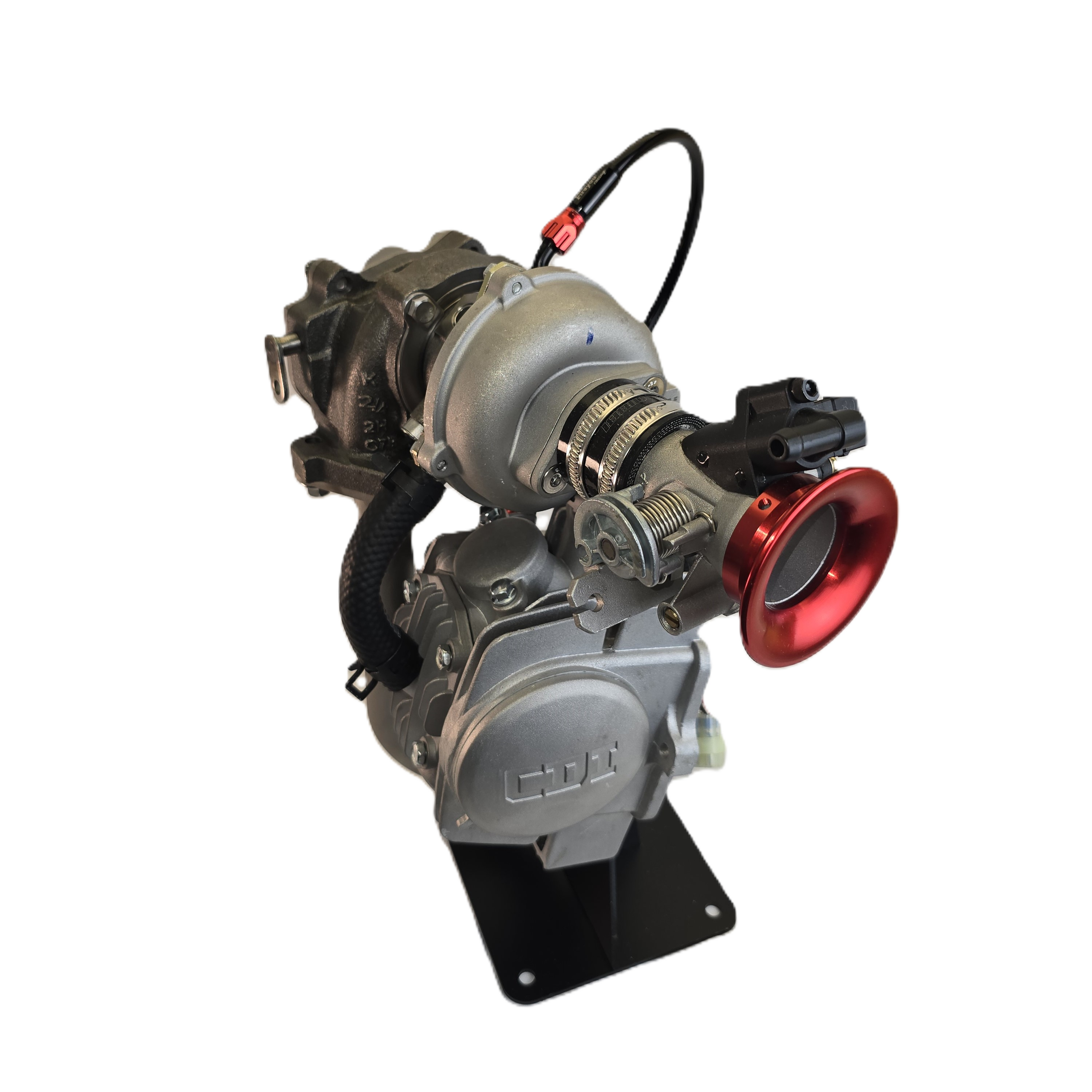
Bolt-on turbo plumbing for horizontal 125cc pit bike engines, built around the smallest manufactured turbocharger — the VZ21 (RHB31 clone). CAD-driven layout, jig-welded stainless hardware, and a kit designed for consistent, repeatable fitment and sensible boost levels.
What This Turbo Kit Is
This kit provides the fabrication-heavy components required to turbocharge a typical horizontal 125cc pit bike engine using the VZ21 / RHB31 turbocharger. Instead of bending tubes and guessing at angles, the header and downpipe follow a CAD-driven layout and are welded on a dedicated fixture so each kit matches the proven geometry.
The system is aimed at low boost in the 4–5 psi range, which these engines handle well when tuned properly. It gives you a predictable, repeatable foundation for experimenting with small-engine turbocharging without building every part from scratch.
The kit also includes a bolt-on oil supply and return system, so the turbo receives pressurized oil without drilling or modifying the crankcase. Oil drains cleanly through a dedicated return path.
In the DP Design Fab Turbo Plumbing Kit
- 316 stainless turbo header / J-pipe, jig-welded on a master fixture
- 316 stainless downpipe, compact and free-flowing
- Turbo flange and hardware for the VZ21 / RHB31 frame turbo
- 26mm carb/throttle-body adapter designed specifically for the VZ21 inlet geometry
- Bolt-on turbo oil supply and return components (no case drilling required)
- Gaskets, studs, and basic mounting hardware (subject to final kit spec)
- Instructions and baseline setup notes for a typical 125cc pit bike
You Supply / Handle
- VZ21 / RHB31 turbocharger itself
- Carburetor or throttle body jetting and fuel system changes
- Boost control (wastegate screw, spring, or external control if you get wild)
- Any frame-specific bracket tweaks or heat shielding
Final kit contents may evolve as production is refined.
What Installation Looks Like
- Remove the stock header and exhaust, carb, and side covers as needed.
- Install the turbo header/J-pipe to the cylinder head using the included studs and copper gasket.
- Mount the VZ21 turbo to the header flange and loosely clock compressor and turbine housings.
- Fit the downpipe to the turbo outlet and frame, then snug everything once clearances look good.
- Route and secure the supplied oil feed and return components to the engine and turbo.
- Install the 26mm carb adapter and reconnect your carb/throttle body, boost reference lines, and any sensors you’re running.
Running 4–5 psi Safely
- Target modest boost: around 4–5 psi on a healthy 125cc with ~9:1 compression.
- Run fresh premium fuel (91+ octane where available).
- Use a wideband O₂ sensor if you can – it makes jetting and mixture control much easier.
- Listen for detonation and be willing to back off if conditions (heat, load, elevation) change.
- Accept that you’re adding heat and load to a small engine that wasn’t designed for boost.
On my own test bikes I’ve run extended full-throttle pulls at ~5 psi with good results, but every engine, fuel, and environment is different. This is experimental hardware; use your judgment.
Which Bikes This Targets
The kit is designed around a typical horizontal 125cc pit bike engine. That covers a wide range of pit bikes and knockoff engines that share similar geometry. If your engine looks like a Lifan-style 125 and there’s reasonable room near the head for a small turbo, this layout is aimed at you.
- Horizontal 125cc pit bike engines (Lifan/clone style)
- Common pit bike frames with room near the head
- Small-engine projects where you can physically place a VZ21 near the cylinder
Because frames, pegs, and plastics vary, expect minor tweaks on some bikes. The goal is for the header/turbo/downpipe geometry to be consistent; the last bit of fitting is always specific to your build.
What This Kit Is Good For
- Experimenting with small-engine turbocharging without building everything from scratch.
- Building a fun, punchy pit bike for track days, play riding, or hill climbs.
- Using as a development mule to learn about boost, fueling, and engine data on something cheap.
- R&D for your own future turbo builds or products.
This is not positioned as an OEM-style emissions-legal, warranty-friendly kit. It’s a well-thought-out starting point for builders who understand that turbocharging anything has tradeoffs.
FAQ & Expectations
Does this include the turbocharger?
No. The kit is built around the VZ21 / RHB31 frame turbo, but you source the turbo itself. That keeps costs in check and lets you choose from the many vendors selling the same core unit. Turbo requires minor modification to accomodate studs on head.
Will this instantly double my horsepower?
No magic here. A few pounds of boost on a small engine can make it feel like a different bike, but the focus is a reliable, repeatable setup in the 4–5 psi range, not 'turn it up until it blows up.' It takes roughly 15psi of boost to double your power, so at 5psi a roughly 33% increase in power is a reasonable expectation.
Is this a direct bolt-on for every pit bike?
It’s a direct bolt-on for the engine and turbo layout it was designed around, and a “very close” fit for most similar bikes. Frame details vary; expect minor tweaks on some platforms.
Is there an oiling solution for the turbo?
Yes. The kit includes a bolt-on oil supply and return system that taps into the engine’s pressurized oil circuit and returns oil through a dedicated path—no crankcase drilling required.
Off-road / closed-course use only. You are responsible for how and where you ride, and for monitoring temperatures, fueling, and engine health. This page is a snapshot of a development project that will continue to evolve as more hours go on the hardware.